
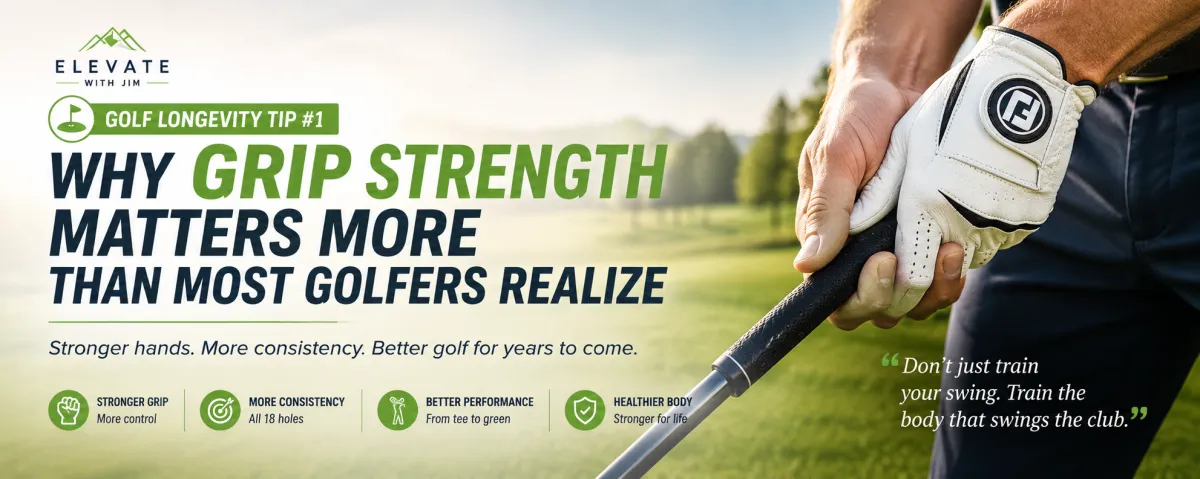
Why Grip Strength Matters More Than Most Golfers Realize
A funny thing happened when I started playing golf regularly again in my 50s.
I expected to lose distance.
I expected to be a little stiffer.
I even expected my back to complain after a round.
What I didn't expect was for my hands to get tired.
By the last few holes, I could actually feel my grip getting weaker.
The club just didn't feel as secure in my hands.
Looking back, it's no surprise.
I had spent nearly 30 years playing only a couple of rounds each year. Somewhere along the way, I had quietly lost strength—not just in my legs or my core, but in my hands and forearms.
The result?
It became harder to make a consistent swing late in the round.
The funny part is...
I never set out to improve my grip strength.
When I began strength training, my goal was simple: build a stronger body for golf.
I started doing exercises like seated rows, lat pulldowns, and dumbbell rows.
At first, something unexpected happened.
My hands gave out before my back muscles did.
I wasn't limited by the muscles I was trying to train.
I was limited by my grip.
Week after week, though, something changed.
Without ever doing a single "grip exercise," my hands became stronger because they were forced to hold onto heavier weights during pulling movements.
Today, I don't think about my grip anymore.
My hands don't get tired during a workout.
More importantly...
They don't get tired during a round of golf.
And that means one less thing standing between me and making the same swing on the 18th hole that I made on the first.
What the Experts Say
This wasn't just my experience.
Dr. Peter Attia frequently points out that grip strength is one of the strongest indicators of healthy aging. He notes that grip strength reflects far more than just strong hands—it serves as a practical marker of overall muscle strength, muscle mass, and functional capacity as we age.
For golfers, that matters.
A stronger grip can help you:
Maintain control of the club throughout the entire round.
Reduce fatigue in your hands and forearms.
Improve consistency, especially late in the day.
Support overall strength that benefits every part of your golf swing.
The good news?
You don't need to spend hours squeezing hand grippers.
Compound pulling exercises like rows, pulldowns, assisted pull-ups, and even carrying heavy dumbbells naturally build grip strength while strengthening the rest of your body at the same time. Progressive strength training also helps counter the natural decline in muscle strength that comes with aging.
Jim's Take
One of the biggest lessons I've learned over the past few years is that golf doesn't always require golf-specific solutions.
Sometimes the best way to improve your golf game is simply to become a stronger, healthier person.
That's certainly what happened with my grip.
I never trained my hands directly.
I simply became stronger.
And my golf improved because of it.
This Week's Challenge
During your next strength workout, pay attention to your hands.
If your grip gives out before the muscles you're trying to work...
That's not a weakness.
It's an opportunity.
Stick with it.
Over time, you'll likely notice the same thing I did—not only do your workouts become easier, but those last few holes become a whole lot more consistent.
Jim's Golf Tip
Don't just train your golf swing. Train the body that swings the club.
Until next week ... Move Better. Eat Better. Play Better.
Jim